
How to Use a 90 Degree Corner Clamp
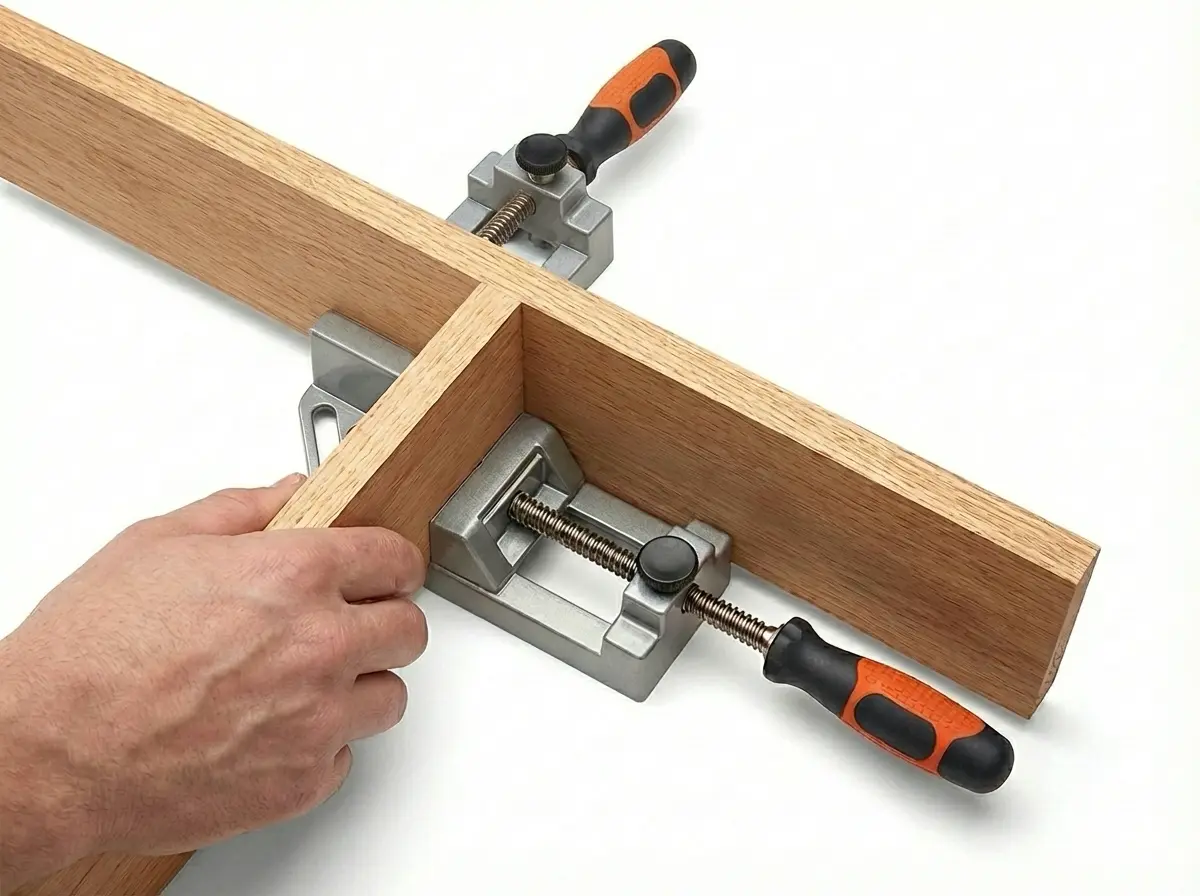
How to Use a 90 Degree Corner Clamp — Plus Every Glue & Joint You Need
From choosing the right wood glue to mastering miter joints with a 90 degree corner clamp — everything beginners actually need in one place.
What Is Wood Glue Made Of?
Wood glue isn’t one product — it’s a whole family of adhesives, each engineered for a different scenario. Understanding which one to reach for is the first step to joints that last.
Polyvinyl Acetate
The workshop classic. Soaks into wood fibers and cures stronger than most softwoods. Non-toxic, sandable, and the backbone of all furniture joinery.
Cyanoacrylate
Cures in seconds using surface moisture. The woodworker’s tape — great for tacking, stabilizing soft grain, or hairline repairs without clamps.
Gorilla Glue
Expands as it cures to fill gaps and bond uneven surfaces. Works on more materials than PVA, but PVA makes a stronger pure wood-to-wood bond.
But glue alone doesn’t make a joint — it just fills the space between two surfaces. The quality of that joint is decided by how you cut it, how you clamp it, and what type of joint you choose in the first place.
Woodworking Joint Types: The Foundation of Every Project
Before you open the glue bottle, you need to understand what kind of joint you’re making. Different woodworking joint types have very different strength characteristics — and each one pairs best with specific clamping strategies.
-
Butt Joint BeginnerThe simplest: two flat faces at a right angle. Easy to cut, weakest option. Always reinforce with dowels, pocket screws, or biscuits on structural pieces.
-
Edge Joint IntermediateBoards joined face-to-face along their length — the method for cutting boards and tabletops. PVA excels here. Needs multiple clamps every 6–8 inches.
-
Mortise & Tenon AdvancedThe gold standard for frame-and-panel work. A tenon fits a mortise for a mechanical interlock before glue dries. Precision cutting is non-negotiable.
-
Dovetail AdvancedResists pulling apart better than any other joint. Used in drawer boxes and case construction. Requires a good saw and patience.
-
Pocket Hole BeginnerThe modern shortcut. A jig drills an angled pilot hole a screw drives through, pulling pieces tightly without traditional joinery. Fast, strong, forgiving.
Search Interest for Pocket Hole Jig: Why Everyone Is Talking About It
If you’ve been researching woodworking recently, you’ve noticed pocket hole jig searches are surging — and for good reason. Pocket hole joinery is the single fastest way a beginner can build furniture that actually holds up.
- No complex measuring or hand-cut joinery required
- Works on solid wood, plywood, and MDF
- Joints can be assembled without clamps — the screw does the clamping
- Ideal for face frames, cabinet boxes, tabletops, and bench builds
For best results, pair your pocket hole jig with PVA glue on the mating surfaces. The glue adds long-term rigidity; the screw holds everything in place while it cures. No clamp wait time. No alignment drift.
Pro tip: A pocket hole jig is one of the highest-ROI purchases in any beginner shop. It turns a half-day joinery project into a 20-minute build — without sacrificing structural integrity.
Types of Woodworking Clamps (And What Each One Is For)
Every joint — glued or screwed — benefits from the right clamping setup. The problem is that “clamp” means six different things depending on what you’re building.
Bar Clamps
The workhorses. A long bar with a sliding jaw, 12″ to 8′. Built for tabletops, door frames, and wide panel glue-ups.
F-Clamps
Concentrated screw pressure in an F-profile. Great for edge gluing, holding jigs, and one-handed operation on smaller work.
Pipe Clamps
Standard plumbing pipe as the bar with separate jaw heads. Inexpensive, infinitely adjustable, ideal for large furniture builds.
Spring Clamps
Fast and light-duty. For holding thin pieces during glue-ups when heavier clamps aren’t worth the setup time.
Corner Clamps
Hold two pieces at exactly 90°. Essential for picture frames, boxes, and face frames where a square joint is mandatory.
Band Clamps
Strap wraps irregular shapes — chairs, round frames, anything a jaw clamp can’t grip evenly.
Compare Bar Clamp and F-Clamp: Which One Do You Actually Need?
When you compare bar clamps and F-clamps, the difference comes down to jaw depth, clamping pressure, and speed. Here’s how they stack up:
| Feature | Bar Clamp | F-Clamp |
|---|---|---|
| Best for | Wide panels, long glue-ups | Edge work, jigs, small assemblies |
| Pressure style | Even, distributed | Concentrated, screw-driven |
| One-handed use | Difficult | Yes (quick-release models) |
| Throat depth | Shallow | Deeper on most models |
| Price per clamp | Higher | More affordable |
| Typical sizes | 24″–96″ | 4″–24″ |
The honest verdict: Building furniture with wide panels — tables, benches, cabinet carcasses? Buy bar clamps first. Doing edge work, jig setups, or small boxes? Start with F-clamps. Most shops eventually need both.
Clamps for Miter Joints: A Special Case
Miter joints are beautiful — and notoriously difficult to clamp. When two angled faces meet, standard jaw clamps slide off under pressure and can skew the joint before the glue sets.
- Band clamps wrapped around the full frame apply equal pressure to all four corners simultaneously. Ideal for picture frames and small cabinet doors.
- Corner clamps hold a single corner at 90° while you nail, screw, or wait for glue to cure. Good for assembling each joint individually.
- Miter vises hold one angle while you drive a fastener from above — useful for case corners and decorative trim.
One technique most beginners miss: tape across the miter joint before cutting. Fold the four sides flat, apply glue, fold them back into a box, and tape the last corner. The tape acts as a perfect band clamp for small frames — no hardware needed.
PVA Glue for Wood: The Everyday Standard
For most joinery — edge joints, face frames, mortise-and-tenon — yellow PVA is the right call. Applied to a tight joint with proper clamping, it’s stronger than the wood itself.
Yellow PVA (aliphatic resin) offers better heat and moisture resistance than white PVA, making it the preferred choice for furniture and cabinetry. The key is surface contact: tight joints, even clamping pressure every 6–8 inches, and a full cure before the piece goes under load.
Most PVA glues reach working strength at 30–60 minutes, but full cure takes 24 hours. A half-cured joint is weaker than no joint at all — don’t rush it.
Best Wood Glue for Outdoor Use
Standard PVA is not waterproof. It softens with moisture and will fail on any exterior project within a season or two. For outdoor furniture, planters, and deck elements, you need a different approach.
-
Type II PVA Water-resistantRated for exterior use with occasional exposure. Good for covered outdoor furniture and projects with indirect moisture contact.
-
Type I PVA WaterproofPasses ANSI/HPVA Type I testing. Titebond III is the benchmark. Suitable for garden furniture, raised beds, and direct rain exposure.
-
Epoxy Marine-gradeTwo-part, fully waterproof, chemically inert. Reserved for marine builds, ground-contact, or extreme humidity environments.
“Water resistant” and “waterproof” are not interchangeable. Always check the label before gluing anything that lives outside.
Solid Wood Cutting Board: The Truth About Glue and Food Safety
The search for “solid wood cutting board no glue” reveals a real concern — but it’s based on a misconception. A properly built cutting board absolutely uses glue, and that glue is completely safe.
FDA-compliant PVA adhesives like Titebond III are approved for indirect food contact once cured. The glue line is inert — it doesn’t leach, absorb water, or harbor bacteria any more than the wood around it.
What makes a cutting board food-safe isn’t the absence of glue — it’s the right glue, the right finish (food-grade mineral oil or butcher block wax), and a close-grained hardwood like maple, walnut, or cherry. A properly glued edge-grain or end-grain board is also more dimensionally stable than a solid slab, as alternating grain direction controls wood movement and prevents warping.
Mulch Glue: Does It Work?
Mulch glue (landscape glue or ground cover adhesive) is a diluted PVA-based product sprayed over fresh mulch to lock it in place. It dries clear and invisible.
- Slopes and hillsides where mulch washes away in rain
- High-traffic landscaping areas prone to scatter
- Decorative beds near driveways or paths
One application typically lasts a season or two before the mulch breaks down naturally. It won’t eliminate movement entirely, but significantly reduces scatter and displacement.
Best Woodworking Tools for Beginners: An Honest Starter Kit
If you’re building out your first shop, the list of tools can feel overwhelming. Here’s what actually matters for the projects most beginners tackle first.
Measuring & Marking
A combination square and marking gauge. These two tools prevent more failed cuts than anything else in the shop.
Cutting
Circular saw for sheet goods, miter saw for crosscuts and angles, jigsaw for curves.
Joinery
A pocket hole jig is the fastest way to expand what you can build in year one. Add a biscuit joiner later for panel work.
Clamping
Start with 4 bar clamps (24–36″) and 4 F-clamps. Add corner clamps once you start building boxes and frames.
Sanding & Finishing
A random orbital sander and a basic set of chisels will cover most finishing needs.
Adhesives
Titebond II or III for glue-ups, medium CA glue for repairs, and CA accelerator for fast work.
The most important lesson: Spend more on clamps than you think you need. Glue joints don’t fail because of bad glue — they fail because of uneven or insufficient clamping pressure. Most beginners start with too few and spend years working around it.
Quick Reference: Glue + Clamp by Joint Type
A practical cheat sheet for the most common woodworking scenarios.
| Joint Type | Best Glue | Best Clamp |
|---|---|---|
| Edge joint (tabletop) | Titebond II/III | Bar clamps every 6–8″ |
| Pocket hole joint | PVA + screw | No clamp needed |
| Miter joint | PVA | Band clamp or corner clamp |
| Mortise & tenon | PVA | Light bar or F-clamp |
| Butt joint (reinforced) | PVA | F-clamps |
| Outdoor furniture | Titebond III | Bar clamps |
| Small repair / tack | CA glue | Spring clamp or none |
Get the Tools That Make Every Joint Hold
A solid glue joint isn’t luck. It’s a precise cut, the right adhesive, and a clamp that holds everything exactly where you left it while chemistry does its job.